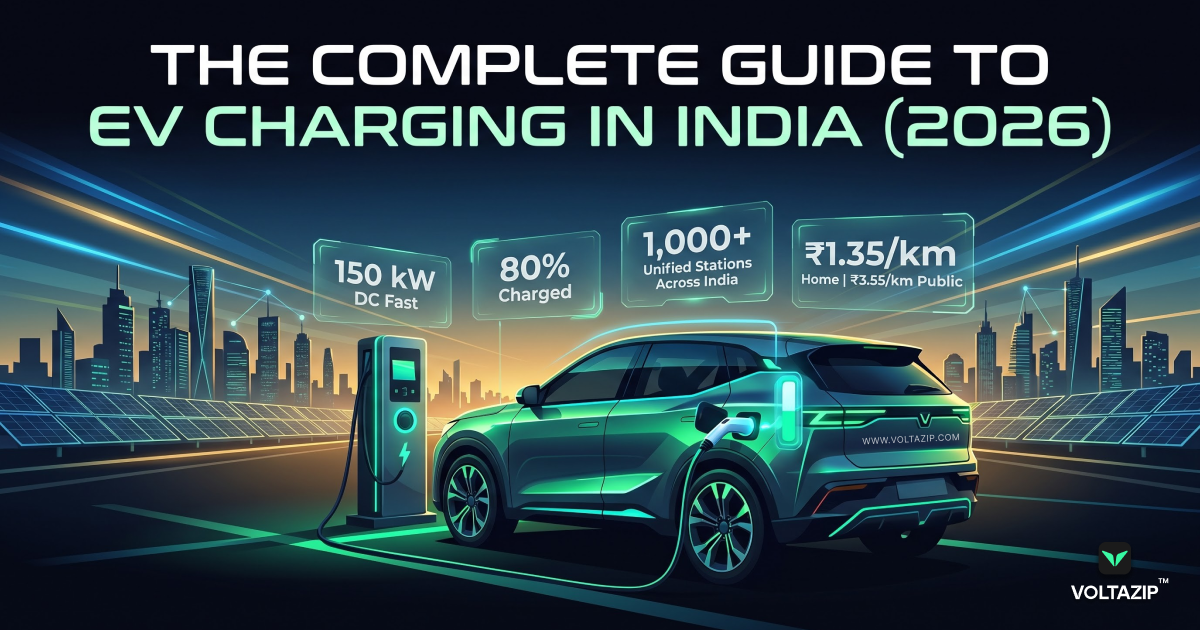
Electric vehicle adoption across India has crossed a decisive tipping point. With over a million EVs hitting Indian roads—from commuter two-wheelers and compact urban hatchbacks to 500+ km highway SUVs—the most crucial question for prospective and current EV owners has shifted from “Should I buy an EV?” to “How do I seamlessly charge it everywhere I go?”
Public charging infrastructure in India has expanded dramatically across national highways and metro centers like Delhi-NCR, Mumbai, Bengaluru, Chennai, and Hyderabad. However, the ecosystem remains fragmented across dozens of Charge Point Operators (CPOs), varying state electricity tariffs, and distinct plug standards.
This master guide covers the complete spectrum of EV charging in India in 2026: connector standards, home wall-box installations, real-world tariffs, public fast-charging networks, highway navigation rules, and how to eliminate multi-app fatigue.
Quick Navigation Index
- 1. Understanding EV Connector Types in India
- 2. Home AC Charging vs. Public DC Fast Charging
- 3. Real-World Charging Costs & Tariff Structures
- 4. Finding Chargers & Navigating Metro Networks
- 5. Comparing India’s Top CPO Networks
- 6. Long-Distance Highway Planning & Range Anxiety
- 7. The Future of Charging: CPO Aggregation
1. Understanding EV Connector Types in India
Before pulling up to a public station, you must identify which charging standard your vehicle uses. India’s passenger EV market has standardized around a few primary connector heads:
| Connector Standard | Power Type | Typical Speeds | Compatible Vehicles / Use Case |
|---|---|---|---|
| Type-2 AC | AC (Single/Three Phase) | 3.3 kW to 22 kW | All 4W EVs (Home wall-boxes, malls, office parks) |
| CCS2 (Combined Charging System) | DC Fast Charging | 25 kW to 150 kW+ | De-facto national 4W highway standard (Tata, Mahindra, MG, Hyundai, BYD) |
| GB/T & Bharat DC-001 | Low-Voltage DC | 10 kW to 15 kW | Legacy commercial fleets, older e-Tigor / e-Verito cabs |
| LEACS / Light EV Plugs | AC / DC Low Voltage | 1.5 kW to 6 kW | Electric 2-Wheelers & 3-Wheelers (Ather, Ola, TVS, Bajaj) |
2. Home AC Charging vs. Public DC Fast Charging
Understanding power delivery is essential for optimizing battery health and personal operating costs:
- Home AC Slow Charging (3.3 kW – 7.4 kW): Electricity is supplied as Alternating Current (AC). The vehicle’s On-Board Charger (OBC) converts it to Direct Current (DC) to feed the lithium-ion cells. This is the gentlest method for preserving battery state-of-health (SoH) over a vehicle’s lifespan.
- Public DC Fast Charging (25 kW – 150 kW+): The off-board fast charger converts grid AC power into high-voltage DC directly inside the station cabinet, bypassing the car’s internal OBC. Power flows straight into the battery pack, enabling 10% to 80% charge sessions in 30–45 minutes.
3. Real-World Charging Costs & Tariff Structures
Running costs vary substantially between charging in your apartment/garage versus utilizing highway fast-charging corridors.
| Location / Charging Type | Average Tariff Rate | Loss-Adjusted Cost / km* | Monthly Cost (1,200 km) |
|---|---|---|---|
| Home AC (Residential Slab) | ₹6 – ₹10 / kWh | ₹1.35 / km | ₹1,620 |
| Public Destination AC | ₹10 – ₹15 / kWh | ₹2.03 / km | ₹2,436 |
| Public Highway Fast DC | ₹18 – ₹25 / kWh | ₹3.55 / km | ₹4,260 |
| Petrol SUV (Baseline) | ₹103 / Litre (14 km/l) | ₹7.35 / km | ₹8,820 |
*Calculated using a compact electric SUV efficiency of 6.5 km/kWh with 10% AC conversion loss and 5% DC loss factors.
For a deep dive into state DISCOM Time-of-Day (ToD) off-peak rates, read our detailed guide:
👉 How Much Does It Really Cost to Charge an EV in India? (2026 Data)
4. Finding Chargers & Navigating Metro Networks
Searching for chargers in high-density metros like Delhi, Mumbai, or Bengaluru requires real-time information. A static pin drop on traditional navigation apps won’t inform you if a charger is occupied by a commercial fleet, offline due to local grid faults, or restricted behind private residential gates.
Essential Rules for City Charging:
- Filter by Public Access: Avoid pulling up to restricted commercial fleet hubs.
- Verify Connector Speed: Ensure destination AC plugs deliver at least 7.4 kW for meaningful top-ups during short 2-hour parking stays.
- Check Live Availability: Always confirm charger status before driving across town during peak commute hours.
For city-specific density breakdowns across major metro regions, check our local navigation breakdown:
👉 EV Charging Stations Near Me: How to Find Chargers in Every Indian City
5. Comparing India’s Top CPO Networks
The public charging landscape in India is spearheaded by major infrastructure providers, each presenting unique footprint advantages:
- Tata Power EZ Charge: The largest nationwide presence with 5,500+ public and captive plugs. Highly dominant at hotel chains, shopping malls, and Tata dealerships.
- Statiq: Rapidly growing Northern and Western corridor network featuring strong integrations with highway food plazas and dhabas.
- ChargeZone: Focused on high-speed dual-gun DC cabinets (60 kW to 150 kW+) designed for heavy expressways and long-distance transit.
For an head-to-head comparison of uptime, pricing, and app usability across these operators, read:
👉 Tata Power vs. Statiq vs. ChargeZone: Which Network Is Best for You?
6. Long-Distance Highway Planning & Range Anxiety
Driving an EV across national highways (such as NH-48 Bengaluru–Mumbai or NH-44 Delhi–Agra) is straightforward when adhering to five essential habits:
- The ABC Rule (Always Be Charging): Top up at functional fast chargers along your route rather than draining down to 5% State of Charge.
- Maintain a 20% SoC Reserve: Always schedule arrival stops with a 20% battery cushion to account for unexpected detours or occupied stations.
- Target 60 kW+ Dual-Gun Units: Avoid queue bottlenecks by choosing stations that handle multiple vehicles simultaneously.
- Pack a Portable 16A Trickle Cable: A 3.3 kW portable cable paired with an extension cord allows charging from any 16A industrial socket at dhabas or hotels.
- Reset Emergency Stop Switches: If a DC charger appears dead, check if the red physical Emergency Stop latch was pressed by a previous user and twist clockwise to reset.
For a full step-by-step route planning masterclass, read our complete guide:
👉 How to Plan a Long-Distance EV Road Trip in India (Without Range Anxiety)
7. The Future of Charging: CPO Aggregation
The primary friction point for EV drivers in India remains network fragmentation. Managing over a dozen separate mobile applications, maintaining pre-funded digital wallets across competing operators, and switching between mapping interfaces creates unnecessary friction.
Unified CPO aggregation solves this by bringing live status feeds, real-time pricing comparisons, and multi-network routing into a single interface.
Tired of switching between multiple charging apps? Download Voltazip free on Google Play to search every major CPO network across India on one map, compare live unit prices, check real-time charger health, and plan long-distance routes with complete confidence.