If you drive an electric vehicle in India, your phone’s home screen probably looks like a collection of charging apps: Tata Power EZ Charge, Statiq, ChargeZone, Jio-bp Pulse, and Zeon Charging.
Each Charge Point Operator (CPO) claims to have the largest network, the fastest chargers, and the most reliable uptime. But when you are sitting at 12% State of Charge (SoC) on a highway or navigating a busy metro city, which network should you actually rely on?
This article provides an unvarnished comparison of India’s top three CPO networks—Tata Power EZ Charge, Statiq, and ChargeZone—evaluating highway density, hardware reliability, pricing transparency, and real-world app usability.
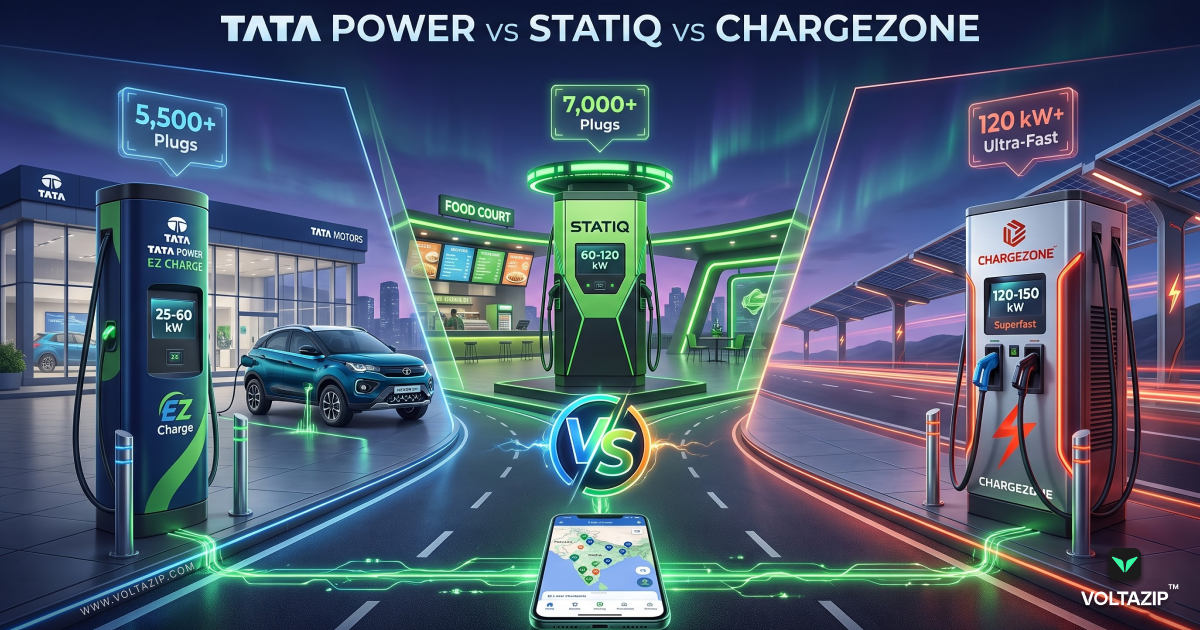
At a Glance: India’s Big Three Charging Networks
| Network Feature | Tata Power EZ Charge | Statiq | ChargeZone |
|---|---|---|---|
| Network Size & Scope | 5,500+ Public & Captive Plugs | 7,000+ Aggregated & Owned Plugs | 3,000+ High-Speed DC Ports |
| Primary Strength | City density & OEM tie-ups | Semi-urban & North India coverage | Ultra-fast highway DC hubs (120 kW+) |
| Avg. DC Fast Tariff | ₹18 – ₹22 / kWh | ₹18 – ₹24 / kWh | ₹20 – ₹25 / kWh |
| Typical Hardware Speeds | 25 kW, 30 kW, 60 kW DC | 30 kW, 60 kW, 120 kW DC | 60 kW, 120 kW, 150 kW+ Dual DC |
| Payment Method | In-app Wallet / RFID Card | Statiq Wallet / UPI Direct | In-app Wallet / Auto-charge |
1. Tata Power EZ Charge: The Legacy Giant
As an early mover in Indian EV infrastructure, Tata Power operates the most geographically diverse footprint in the country.
Strengths
- Unrivaled Metro & Tier-2 Presence: Tata Power dominates hotel chains (Taj, Marriott), shopping malls, Tata Motors dealerships, and urban parking structures.
- OEM Integration: Deep integration with Tata Passenger Electric Mobility (Nexon.ev, Punch.ev, Tiago.ev) offers streamlined wallet management and RFID card activation for Tata EV owners.
- Consistent Pricing: Rates remain predictable across regions, generally hovering between ₹18 and ₹22 per kWh for DC fast charging.
Weaknesses
- Legacy 25 kW Hardware Bottlenecks: A significant portion of Tata’s older highway infrastructure consists of single-gun 25 kW or 30 kW DC fast chargers. These take 60–90 minutes to charge modern 40 kWh+ battery packs, leading to long queues at popular stops.
- App Glitches & Stale Statuses: The EZ Charge app occasionally reports offline or broken chargers as “Available,” resulting in unexpected arrival issues.
2. Statiq: The Fast-Growing Aggregator & Operator
Statiq has built a large footprint across Northern and Western India by pairing its proprietary hardware deployment with third-party host partnerships.
Strengths
- Rapid Expansion & Tech Focus: Statiq’s mobile app offers a clean UI, seamless UPI payment integration, and quick station discovery.
- Highway Food Court Plugs: Strong partnerships with highway food hubs (McDonald’s, KFC, major dhabas) make planning meal-break charging sessions straightforward.
- Peer-to-Peer & Host Network: Allows private hosts and commercial property owners to list chargers on their network, improving coverage in Tier-2 and Tier-3 towns.
Weaknesses
- Variable Third-Party Maintenance: Because Statiq integrates third-party host chargers onto its platform, hardware maintenance and uptime consistency can vary outside major metro corridors.
- Dynamic Convenience Fees: Certain partner stations add location convenience surcharges, driving final per-kWh rates above ₹24.
3. ChargeZone: The Highway Ultra-Fast Specialist
ChargeZone focuses heavily on high-power DC fast charging corridors, catering to long-distance highway drivers and fleet operators.
Strengths
- High-Power Dual-Gun Cabinets: ChargeZone installs 60 kW, 120 kW, and 150 kW dual-gun liquid-cooled DC fast chargers. These allow two vehicles to charge simultaneously without drop-offs in output power.
- High Uptime & Reliability: Hardware availability and gun locks on ChargeZone’s primary highway corridors show higher operational uptime than legacy city networks.
- Renewable Energy Integration: A growing percentage of ChargeZone stations are tied directly to solar-powered microgrids, helping reduce overall carbon footprints.
Weaknesses
- Higher Tariff Rates: Premium hardware and prime highway real estate push ChargeZone’s rates to ₹20–₹25 per kWh (plus GST).
- Sparse Secondary City Coverage: While excellent on major arterial expressways (e.g., Bengaluru–Chennai, Mumbai–Pune, Delhi–Jaipur), coverage inside secondary urban markets remains limited.
The Ultimate Verdict: Which Network Wins?
- Choose Tata Power EZ Charge if: You commute primarily within metro cities, frequent Tata dealerships, or prioritize predictable, standardized pricing.
- Choose Statiq if: You travel extensively across North India, value a clean app experience, and want integrated food-stop charging options.
- Choose ChargeZone if: You frequently take long-distance highway road trips and need high-speed 120 kW+ dual-gun chargers to minimize stopover times.
Why Choose When You Can Aggregate?
The main challenge for Indian EV owners isn’t choosing a single favorite network—it’s managing multiple distinct apps, separate pre-funded wallets, and disconnected maps.
A station from one network might be occupied, while a functional fast charger from another operator sits empty 300 metres away.
Stop juggling five different charging apps. Download Voltazip free on Google Play to aggregate Tata Power, Statiq, ChargeZone, and 15+ major CPOs into a single map. Filter by live availability, compare per-unit prices in real time, and route-plan efficiently.