The first question every potential EV buyer in India asks is some version of: “What will it actually cost to run?”
It’s the right question. The sticker price of an electric car is only half the story. The other half is the monthly bill, and the gap between home charging and public fast charging is wider than most people realize.
This guide breaks it down with real numbers. No fluff, no sponsored network rankings—just the exact arithmetic of charging an EV in India in 2026.
The Short Answer (If You Only Read One Paragraph)
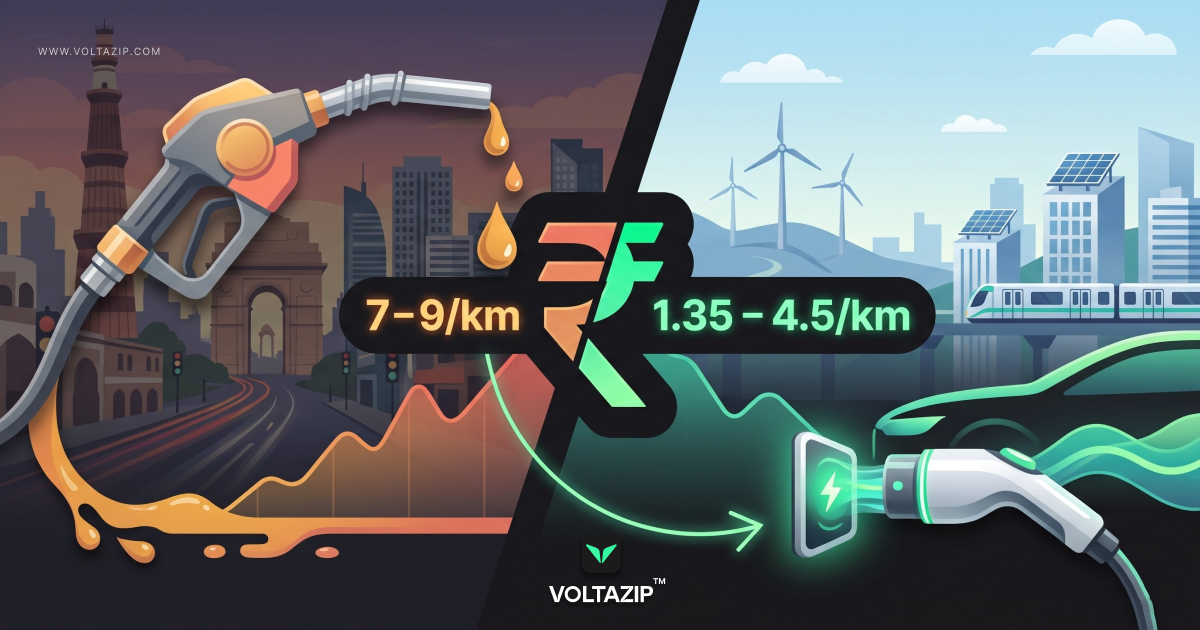
Charging at home costs roughly ₹1 to ₹2 per kilometre. Charging at a public DC fast charger costs ₹3 to ₹4.50 per kilometre. Petrol, at current metro prices, costs ₹7 to ₹9 per kilometre.
If you drive 1,200 km a month, that’s the difference between spending roughly ₹1,600 and ₹9,000–₹10,000 on fuel. Over a year, the savings on charging alone often exceed ₹75,000.
The catch? That home-charging number only holds if you can actually charge at home. Public charging is still 2–3× cheaper than petrol, but it’s not the same story.
Here’s the full breakdown.
The Two Numbers That Decide Everything
EV charging costs in India don’t depend on the car model. They depend on two primary variables:
- Where you charge (Home vs Public)
- When you charge (Day vs Night, if your state offers Time-of-Day tariffs)
Everything else—the battery capacity, the network brand, the app you use—is a second-order detail.
Home Charging: The Real Cost
Residential electricity tariffs in India typically range from ₹6 to ₹10 per unit (kWh), depending on your state and consumption slab.
Some states offer dedicated EV tariffs that are even cheaper. Maharashtra, Karnataka, Delhi, and Tamil Nadu all have EV-specific rates or off-peak windows. In Mumbai, overnight EV tariffs range from ₹5.50 to ₹7.50 per kWh, compared to daytime rates above ₹12.
A 40 kWh battery, charged from empty with a standard 10% AC charging loss, draws roughly 44 units from the grid. At an average rate of ₹8 per unit, that’s ₹352 for a full charge.
A typical compact electric SUV achieves 6.5 km per kWh in mixed city driving. Factoring in the 10% grid loss ($\frac{\text{₹8} \times 1.10}{6.5}$), your real-world running cost is ₹1.35 per kilometre.
At a dedicated off-peak EV tariff of ₹6/unit, that drops to ₹1.01 per kilometre. Under a rupee and a half.
Public AC Charging: The Middle Ground
Public AC chargers (3.3 kW to 7.4 kW destination chargers) cost ₹8 to ₹15 per unit, depending on the city and location network.
At ₹12/unit and 6.5 km/kWh (with ~10% loss), your running cost works out to ₹2.03 per kilometre. Still very economical, but roughly 50% more expensive than charging in your own garage.
Public DC Fast Charging: The Road-Trip Premium
DC fast chargers (25 kW to 150 kW) cost ₹18 to ₹25 per unit across major networks—such as Tata Power EZ Charge, Statiq, ChargeZone, Jio-bp Pulse, and others.
At an average rate of ₹22/unit and 6.5 km/kWh (with a 5% DC loss factor), your cost is ₹3.55 per kilometre.
You are paying for convenience, high-voltage infrastructure, grid connections, and speed. Most operators bundle applicable GST and service charges directly into this rate, though some bill charges separately at checkout.
Petrol vs Electric: The Real Comparison
Let’s put the numbers side by side. We use a baseline metro petrol price of ₹103 per litre and a real-world city efficiency of 14 km/l for a compact petrol SUV ($\frac{\text{₹103}}{14} \approx \text{₹7.35/km}$).
| Fuel / Charger Type | Cost per km | Monthly Cost (1,200 km) | Yearly Cost (14,400 km) |
|---|---|---|---|
| Petrol SUV | ₹7.35 | ₹8,820 | ₹1,05,840 |
| EV (Home AC) | ₹1.35 | ₹1,620 | ₹19,440 |
| EV (Public AC) | ₹2.03 | ₹2,436 | ₹29,232 |
| EV (Public Fast DC) | ₹3.55 | ₹4,260 | ₹51,120 |
The savings versus petrol are substantial. Even if you rely entirely on public fast charging for all your driving, you still save over ₹54,000 every year on fuel alone.
Most EV owners charge at home 80–90% of the time and reserve public fast chargers for highway road trips. Blended, that puts your average real-world running cost between ₹1.50 and ₹2.00 per kilometre—an 75%+ reduction compared to petrol.
What About Charging Losses?
Every EV incurs charging losses during power delivery. The total electricity drawn from the wall meter is always higher than the net energy stored in the battery due to heat loss during AC-to-DC onboard conversion.
- Home AC Charging: Expect 10–15% loss.
- Public Fast DC Charging: Expect 5–10% loss.
When calculating costs for a 40 kWh battery, account for 44 to 46 units on your billing statement. While it slightly adjusts the math, the overall cost advantage remains dominant.
The State-by-State Factor
Electricity tariffs are managed at the state level in India. Your actual cost will depend on your local DISCOM:
- Tamil Nadu: TANGEDCO’s Time-of-Day tariffs for public charging stations incentivize off-peak and solar-window charging (9:00 AM to 4:00 PM). Fixed charges for HT connections were reduced to ₹138 per kVA/month, drastically reducing operational overhead for network operators.
- Maharashtra: Overnight EV tariffs in Mumbai range from ₹5.50 to ₹7.50/unit, whereas peak daytime rates can exceed ₹12/unit. Scheduling overnight home charging cuts bills in half.
- Karnataka: BESCOM provides streamlined single-window EV connection approvals and dedicated EV tariffs for residential and commercial setups.
Check your DISCOM’s current tariff schedule online by searching "[Your State] EV charging tariff" to verify your local residential slab.
The Cheapest Way to Charge: Home, Overnight
If you can charge at home, do it. If your DISCOM offers a Time-of-Day tariff, schedule your vehicle to draw power during the off-peak window (typically midnight to 6:00 AM or during peak solar hours).
A smart AC charger or heavy-duty smart plug pays for itself within months under Time-of-Day pricing.
If you live in an apartment complex without dedicated charging, public AC chargers at ₹10–12/unit still cost less than a third of petrol per kilometre. Public DC fast charging at ₹20–25/unit is still 50% cheaper.
The Hidden Variable: Network Pricing Transparency
Public charging prices are often difficult to normalize across providers:
Each operator utilizes an independent app, varying service charges, and different billing structures (per-kWh vs per-minute session costs).
The Ministry of Power guidelines cap public service charges at ₹3–₹4 per unit for AC and ₹11–₹13 per unit for DC (excluding GST and local land costs) through March 2028, with lower caps applicable during solar hours (9:00 AM – 4:00 PM). However, because state electricity tariffs vary, the final price per unit displayed in one app may not match another down the street.
The Bottom Line
Charging an EV in India remains far cheaper than running a petrol vehicle:
- Home Charging: ₹1.00–₹1.50 per km (The ideal scenario)
- Public AC: ₹1.80–₹2.50 per km (Great for long park-and-charge stays)
- Public DC Fast Charging: ₹3.00–₹4.50 per km (The highway premium)
The largest remaining variable for drivers is network rate variance—prices can vary by 30% to 50% between different operators for the exact same charger speed in the same city.
Download Voltazip free on Google Play to search every major charging network, filter by real-time price and speed, and route plan with the lowest-cost stops.