The first EV road trip is the one that changes how you think about electric cars. Not because it’s hard — it isn’t, once you know the rules — but because it forces you to plan differently than you would in a petrol car.
The second trip is easy. The third is routine. This guide gets you from “should I risk it?” to “let’s go” with the actual techniques Indian EV owners use on routes like Bengaluru–Mumbai, Delhi–Jaipur, and Chennai–Pondicherry.
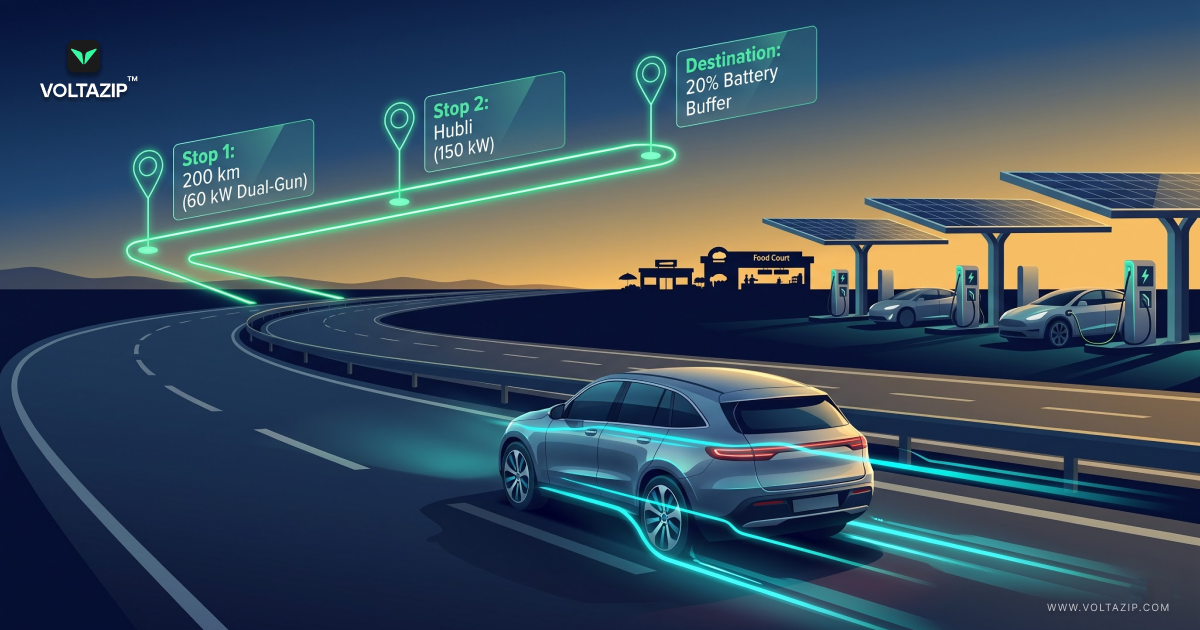
- The ABC Rule: Top up at working chargers along your route rather than waiting for 5% SoC.
- 20% SoC Reserve: Plan all arrival stops with at least 20% battery remaining to absorb delays, broken units, or detour legs.
- Verify Status Live: Cross-check charger operational status on multi-network aggregators like Voltazip before driving to a station.
- Target 60 kW+ Dual-Gun Units: Minimizes queue times and cuts charging speeds from 90 mins down to 25–30 mins.
- Carry a 16A Extension Cable: A portable 3.3 kW trickle charger converts any dhaba or hotel socket into an emergency top-up.
Why Range Anxiety Is Real (And Why It Isn’t the Car’s Fault)
Range anxiety isn’t about the car. Modern EVs have 300–500 km of real-world range. That’s more than enough for any single-day highway leg in India.
The anxiety comes from something more specific: the fear that the charger you’re counting on will be occupied, offline, or non-existent when you get there. That’s a legitimate concern. Public highway infrastructure in India is growing fast, but it’s not uniform. Some corridors have a charger every 60 km. Others have a 200 km gap.
The fix isn’t a bigger battery. It’s better planning. Specifically, it’s five habits.
Habit 1 — The ABC Rule (Always Be Charging)
This is the single most important habit for EV road trips in India.
Never leave a charger without topping up, even if you think you don’t need it.
Sounds wasteful. It isn’t. On a highway route, charging opportunities cluster — you’ll pass three chargers in 80 km, then see none for 150 km. If you skip the cluster thinking “I’ll charge at the next one,” you’re betting that the next one exists, works, and is free.
The ABC Rule says: charge when you can, not when you must. Pull into every stop with a working DC fast charger, even if you only add 20–30%.
In practice, this turns a trip into a series of short 20-minute top-ups rather than one 90-minute charge. It’s faster overall, less stressful, and safer.
Habit 2 — The 20% SoC Buffer
Every EV owner eventually learns this the hard way. Learn it now.
Plan every charging stop assuming you’ll arrive with at least 20% state of charge (SoC).
Why 20% and not 5%?
- The charger might be occupied. You’ll wait 15–45 minutes. During that time, your car shouldn’t be bleeding charge in the sun with the AC running.
- The charger might be broken. You’ll need to reach the next one. That could be 40–80 km away. You need the range to get there.
- Real-world range drops in adverse conditions. Highway speeds, headwinds, rain, and hills all cut into your advertised range. The 20% buffer absorbs this.
- You might need to detour. A missed exit, a closed road, or a last-minute stop for food can add distance you didn’t plan for.
With a 20% buffer, you’re planning for the worst case. In practice, you’ll often arrive with 30–35%, which is fine — you’ll just charge a bit less at the next stop.
Habit 3 — Verify Charger Status Before You Rely On It
This is where most EV road trips go wrong.
You see a charger on a map. You drive to it. You arrive to find it’s either broken, occupied by a fleet vehicle, or requires a different app you don’t have installed.
The fix is to check live status before committing to a stop. Two places to look:
- The charger’s own operator app — Tata Power EZ Charge, Statiq, ChargeZone, Jio-bp Pulse, Zeon. These show real-time status for their own network only.
- A multi-network aggregator app — Voltazip pulls live availability from every major CPO network into one map. You can see if a charger is busy, offline, or under maintenance before you drive to it, and compare prices across networks on the same stretch of highway.
What to look for specifically:
- “Available” vs “Busy” vs “Offline” — most apps now show this; trust the live status, not the map pin
- Connector type and speed — a 25 kW single-gun charger will add an hour to your trip; a 60 kW dual-gun won’t
- Last-reported check-in time — if the last status update was 6 hours ago, call ahead or skip it
- Restrictions — some metro chargers are fleet-only during peak hours; filter for “Public Access”
If two apps disagree on a charger’s status, trust the more pessimistic one. Plan as if the charger is broken, and be pleasantly surprised if it isn’t.
Habit 4 — Target Dual-Gun DC Fast Chargers
Not all DC fast chargers are equal. For highway trips, a few specifications matter.
Target 60 kW or higher. Slower DC chargers — 25 kW, 30 kW — will add 45–90 minutes to a charging stop. You can still use them, but plan them as a fallback, not a primary stop.
Target dual-gun chargers. A single-gun charger means one car at a time. If it’s occupied when you arrive, you’re waiting for the full session. Dual-gun chargers handle two vehicles simultaneously, cutting queue times roughly in half.
Target chargers at highway food courts. Chargers co-located with restaurants — McDonald’s, Starbucks, or even a highway dhaba with a proper parking area — give you a reason to stop for 20–30 minutes that doesn’t feel like wasted time. Restroom, coffee, food, and a top-up in one stop.
Avoid chargers inside paid parking complexes during peak hours. You’ll pay parking on top of charging, and the access might be restricted.
Habit 5 — Carry a Portable Trickle Cable
This is your emergency fallback. A portable 3.3 kW AC cable lets you plug into any standard 16A industrial socket.
Where do you find a 16A socket on a highway?
- Hotels and resorts — most have one for heavy appliances; ask at reception
- Restaurants and dhabas — many will let you plug in if you’re a paying customer
- Small workshops and garages — often have 16A sockets for tools
- Friends’ homes — obviously
Charging at 3.3 kW adds roughly 10–15 km of range per hour. It’s slow. But it’s the difference between being stranded and reaching the next fast charger.
Practical tip: carry a 10-metre extension cable rated for 16A. You’ll often find a socket indoors or in a place a car can’t get close to. The extension bridges the gap.
Planning a Route: A Concrete Example
Let’s walk through a real route — Bengaluru to Mumbai, ~990 km.
Step 1 — Identify the corridor. The Bengaluru–Mumbai route runs on NH-48. It’s one of India’s best-served EV corridors. Most drivers break it into two days.
Step 2 — List the major charging clusters. Chitradurga, Hubli, Belagavi, Kolhapur, Satara, Pune. Each of these towns has 2–4 DC fast chargers, often at fuel stations or highway food courts.
Step 3 — Pick your overnight stop. Hubli or Belagavi is the natural midpoint. Both have hotels with destination chargers.
Step 4 — Plan day 1. Bengaluru → Chitradurga (~200 km) → Hubli (~200 km). Two charging stops, one at each town.
Step 5 — Plan day 2. Hubli → Kolhapur (~180 km) → Pune (~230 km) → Mumbai (~150 km). Three stops.
Step 6 — Verify each stop. Before you leave, check the charger status on the operator app and on a multi-network aggregator. If any primary charger is offline, pick an alternate in the same town — most clusters have 2–3 options.
Step 7 — Apply the buffers. Aim to arrive at each stop with 20% SoC. If you’re projected to arrive with less, add an earlier stop.
That’s the whole plan. Roughly 15 minutes of prep work for a 990 km trip.
What to Do When Things Go Wrong
They will, occasionally. Here’s the playbook.
If the primary charger is offline: use the aggregator to find the next nearest working charger. Don’t wait for the broken one to be fixed. If the next one is 80+ km away, calculate whether you can reach it with your current SoC minus the 20% buffer. If not, look for an AC charger nearby — even a slow one — to add emergency range.
If the charger is occupied: check the queue. If someone just started charging, expect 30–45 minutes. If they’re at 90% and still going, they’re probably unaware of charging etiquette — most drivers will move if asked politely, but not always. Plan an alternate.
If the connector won’t communicate: this happens occasionally with dust or bent pins. Wipe the CCS2 gun head with a cloth. If that doesn’t work, try a different gun on the same charger (if dual-gun). If that doesn’t work, move on.
If you hit the Emergency Stop by accident: twist the red button clockwise to reset the contactor. This is the single most common “charger is broken” issue in India, and it’s usually the previous user’s fault.
The Mindset Shift
The first long EV trip requires more planning than a petrol trip. That’s just true. But the planning becomes habitual fast.
By your third trip, you’ll be doing it on autopilot:
- Top up at every opportunity
- Buffer 20% SoC
- Verify before you drive
- Prefer dual-gun 60 kW chargers
- Carry the trickle cable
None of this is hard. It’s just a new set of habits. And once you have them, long-distance EV travel in India is genuinely easier than petrol — quieter, cheaper, and with fewer stops because you’re charging while you eat instead of detouring to a fuel station.
Planning a long highway trip? Download Voltazip free on Google Play to see every charger on your route, compare live prices across networks, and pick stops that fit your EV’s real range.