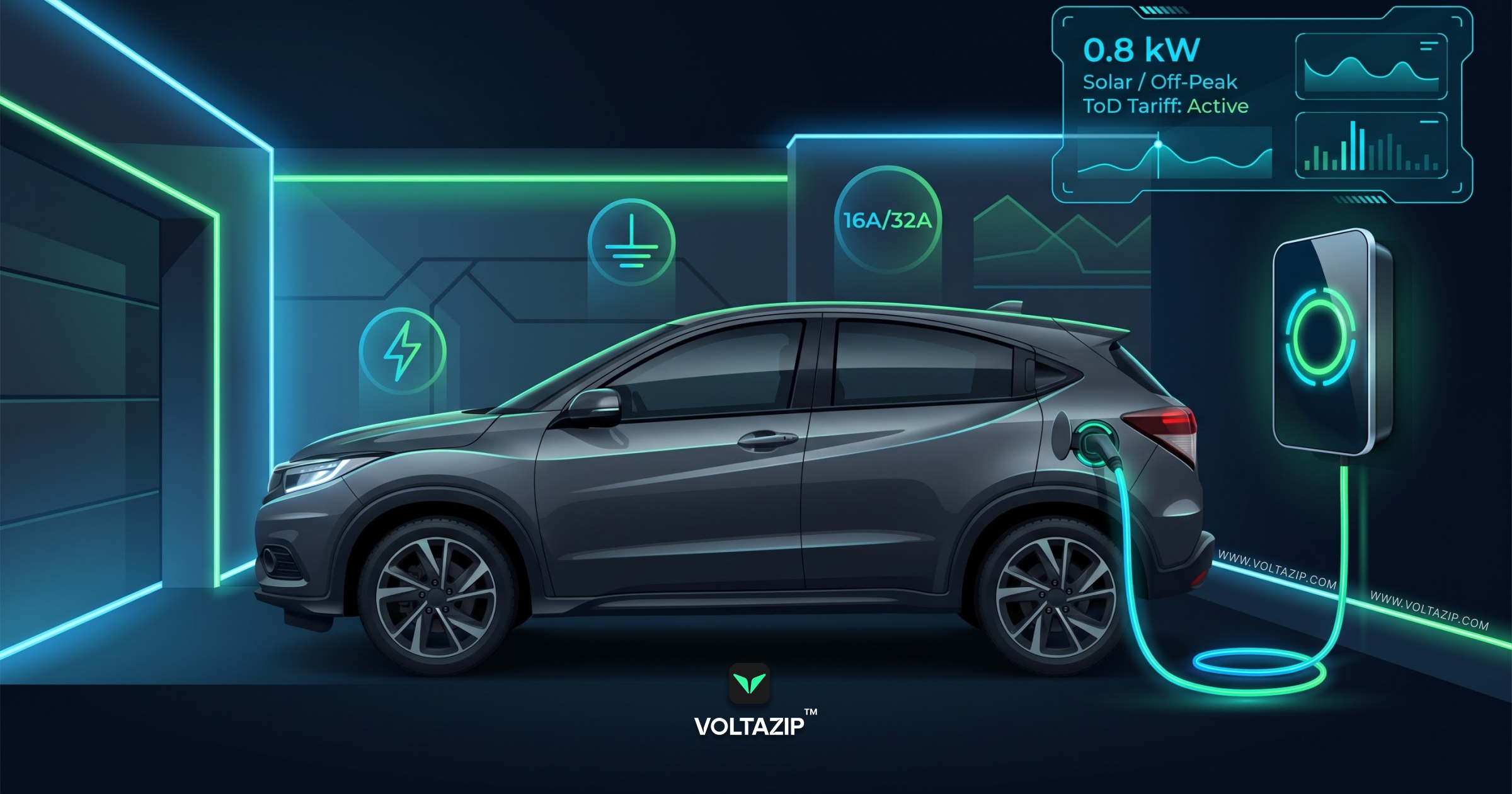
For over 80% of electric vehicle owners in India, home is where 90% of charging happens.
Waking up every morning with a full battery for ₹1.20–₹1.50 per kilometre is the ultimate EV superpower. However, setting up a home charger involves navigating sanctioned electrical loads, DISCOM meter approvals, housing society (RWA) permissions, wiring safety, and time-of-day tariff scheduling.
Whether you live in an independent house or a multi-story apartment complex, this guide covers the complete step-by-step setup process for home EV charging in India in 2026.
- 3.3 kW Portable Plug vs 7.4 kW Wallbox: Portable 16A plugs add ~15–20 km range per hour; 7.4 kW AC wallboxes charge a 40 kWh battery fully overnight (5–6 hours).
- Sanctioned Load Rule: Installing a 7.4 kW wallbox usually requires applying for a load enhancement with your state DISCOM (e.g., Tata Power, MSEDCL, BESCOM, TANGEDCO).
- RWA / Apartment Guidelines: Ministry of Power guidelines state RWAs cannot blanket-ban EV chargers. Power can be routed directly from your sub-meter or common EB connection.
- Lowest Running Cost: Scheduling overnight charging during off-peak Time-of-Day (ToD) tariff windows cuts domestic charging bills by up to 30–40%.
1. 3.3 kW Portable Cable vs 7.4 kW AC Wallbox
When you buy an electric 4-wheeler in India, the manufacturer includes a 3.3 kW portable trickle charging cable (with a 16A plug). You also get the option to install a dedicated 7.4 kW AC smart wallbox.
| Feature | 3.3 kW Portable Plug (16A) | 7.4 kW AC Smart Wallbox |
|---|---|---|
| Charging Speed (Range/Hour) | ~15–20 km per hour | ~40–50 km per hour |
| Full Charge Time (40 kWh Battery) | 12–14 Hours | 5–6 Hours |
| Electrical Requirement | Single-Phase (16A Socket + Earthing) | Single-Phase / Three-Phase (32A Dedicated MCB) |
| Installation Cost | ₹1,500 – ₹3,000 (Dedicated Socket Wiring) | ₹25,000 – ₹45,000 (Included with OEM or Third-Party) |
| Best Use Case | Low daily commutes (<40 km/day), emergency fallback | Daily highway commuters, multiple EVs, quick turnarounds |
2. Check Your Sanctioned Load with Your DISCOM
Every residential electricity connection in India has a Sanctioned Load (measured in kW or kVA) listed on your monthly electricity bill.
- Independent House Example: If your current sanctioned load is 5 kW and you already run two split air conditioners, plugging in a 7.4 kW AC wallbox without increasing your load will trip your main circuit breaker or incur DISCOM penalty charges.
- How to Increase Load: Log in to your electricity DISCOM portal (e.g., BESCOM, Tata Power, MSEDCL, TANGEDCO, BSES) and submit a Load Enhancement Request. Most states offer online approvals within 3 to 7 working days upon paying a nominal security deposit.
3. How to Get EV Charger Approval in an Apartment / RWA
Installing a charger in a multi-story apartment parking slot is a common hurdle for urban EV owners. Here is how to navigate it smoothly:
The Legal Context
Under the Ministry of Housing and Urban Affairs (MoHUA) Model Building Bye-Laws, 20% of all parking spaces in residential buildings are mandated to be EV-ready. RWAs cannot arbitrarily deny permission for personal EV charger installation.
Two Common Wiring Methods for Apartments:
- Direct Connection from Flat’s Meter: Cable is drawn from your apartment’s individual electricity meter directly down to your designated basement parking slot. You pay normal domestic tariff rates directly on your monthly home bill.
- Common Area Feeder + Sub-Meter: Power is pulled from the society’s common electricity panel with an inline smart meter or RFID charger. You reimburse the RWA based on sub-meter readings or through automated CMS apps.
4. Electrical Safety Checklist for Indian Homes
India’s summer heatwaves and heavy monsoon seasons place unique stress on home charging setups. Ensure your technician follows these critical safety measures:
- Dedicated Earthing (Crucial): EVs will reject charging if voltage between Neutral and Earth exceeds 2V–3V. Always ensure a dedicated chemical earth pit or copper rod earthing is connected.
- Correct Wire Gauge: Use a minimum 4.0 sq. mm armored copper cable for 16A 3.3 kW sockets, and 6.0 sq. mm or 10.0 sq. mm cable for 7.4 kW 32A wallboxes.
- Dedicated Protection (RCD / MCB): Never plug an EV into a standard household socket sharing a circuit with other home appliances. Install a dedicated Type-B RCCB/RCD (Residual Current Device) and a properly rated C-Curve MCB.
5. How Much Does Home Charging Cost?
Home charging remains the single cheapest fuel source in India:
- Domestic Tariff Range: ₹6.00 to ₹10.00 per unit (kWh) across most states.
- Full Charge Cost (40 kWh Battery): $\approx 44 \text{ units drawn (with 10% loss)} \times ₹8 = \text{₹352}$.
- Cost Per Km: At 6.5 km/kWh real-world efficiency, your cost is ₹1.35 per kilometre.
- Time-of-Day (ToD) Savings: In states like Maharashtra, Tamil Nadu, and Karnataka, scheduling your wallbox to charge between 11:00 PM and 6:00 AM drops your effective rate to ₹5.50–₹6.50 per unit.
For a full comparison with public fast-charging rates and petrol benchmarks, read our master breakdown:
👉 How Much Does It Really Cost to Charge an EV in India? (2026 Data)
The Complete EV Ecosystem Guide
Home charging powers your daily commute, but for highway road trips, metro fast charging, and CPO comparisons, explore our comprehensive guides:
- Master Guide: The Complete Guide to EV Charging in India (2026 Edition)
- City Navigation: EV Charging Stations Near Me: City-by-City Guide
- Highway Trips: How to Plan a Long-Distance EV Road Trip in India
Planning your next road trip beyond home range? Download Voltazip free on Google Play to search every public charging network across India, check live station status, and compare fast-charger prices in real time.