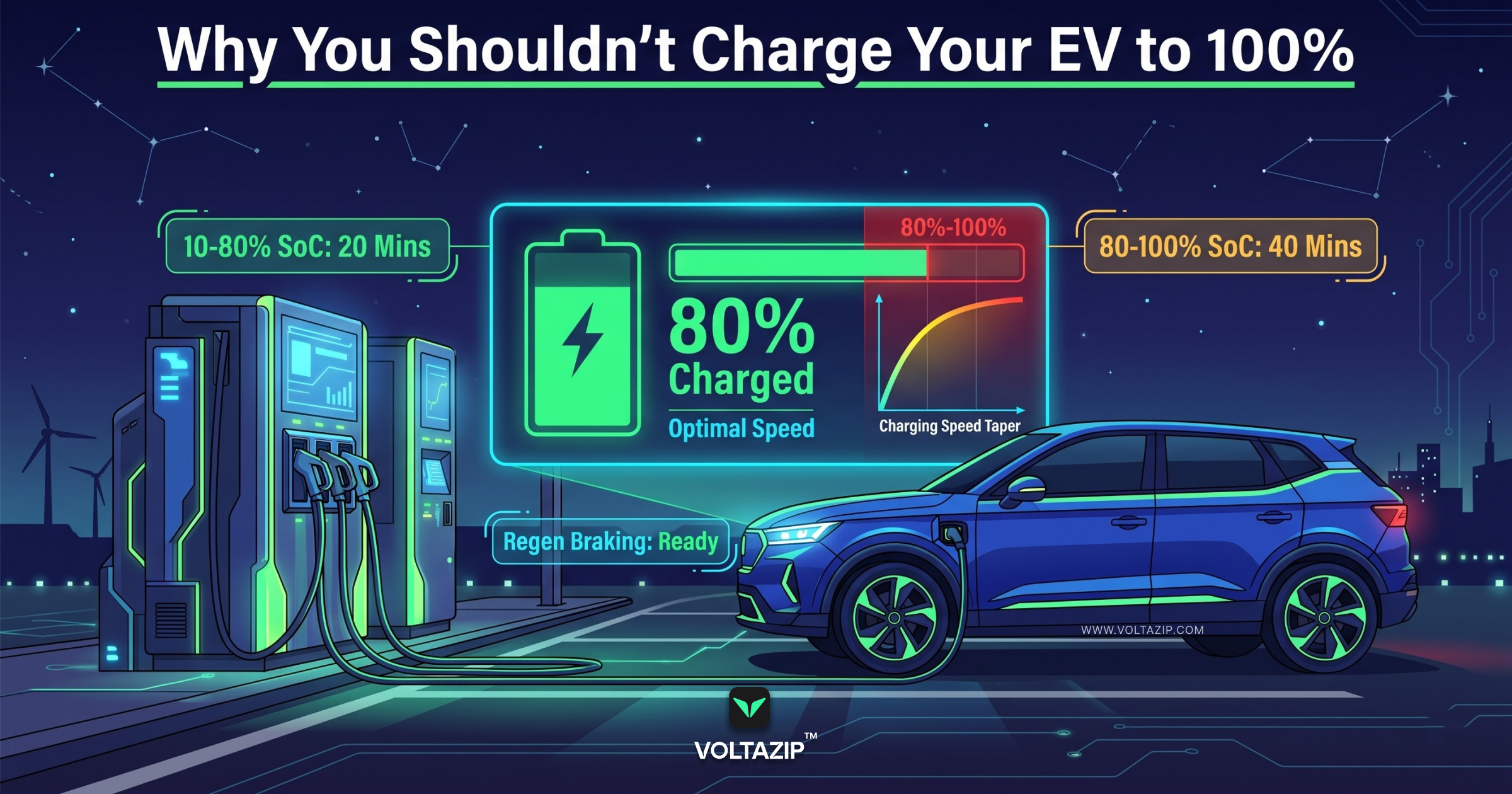
When transitioning from a petrol car to an electric vehicle, intuition tells you to do one thing before embarking on a 500 km highway trip: fill the “tank” to 100%.
However, experienced EV owners and battery engineers—including Elon Musk—frequently advise against routinely charging your battery to 100%, even right before setting out on long-distance trips.
Charging your EV to 100% can actually slow down your total travel time, disable your vehicle’s regenerative braking, and accelerate battery degradation.
This guide covers the technical reasons behind the 80% Charging Rule, when 100% is acceptable, and how battery chemistry (NMC vs. LFP) changes the game.
- The Charging Taper: DC fast chargers slow down exponentially above 80%. Going from 80% to 100% often takes longer than going from 10% to 80%.
- Disabled Regen Braking: At 100% SoC, there is no chemical room in the battery to absorb energy from regenerative braking, forcing your car to use mechanical friction brakes.
- Chemical Stress: Holding a Lithium-ion (NMC) battery at 100% voltage creates high thermal and chemical stress, accelerating capacity loss.
- The LFP Exception: LFP (Lithium Iron Phosphate) batteries tolerate 100% charges much better and require occasional 100% charges to calibrate the Battery Management System (BMS).
1. The “Parking Lot” Analogy: Why Fast Chargers Slow Down Above 80%
Elon Musk famously explained EV battery charging speed using a simple parking lot analogy:
“Imagine a massive parking lot that is completely empty. When cars first start driving in, finding an open parking spot is fast and effortless. But when the lot is 80% full, cars have to slow down, circle around, and carefully navigate into the remaining open spots.”
At a microscopic level, lithium ions inside your battery behave the exact same way.
When your battery is low (10%–50%), a 120 kW DC fast charger pumps electricity at maximum speed. But as the battery approaches 80% State of Charge (SoC), internal resistance rises. To protect the battery cells from overheating or short-circuiting, the vehicle’s Battery Management System (BMS) forces the charger to taper its speed.
| Battery State of Charge (SoC) | Average Fast DC Power | Time Elapsed (Approx.) |
|---|---|---|
| 10% to 50% | 60 kW – 120 kW (Peak Speed) | 12 Minutes |
| 50% to 80% | 35 kW – 60 kW (Tapering) | 15 Minutes |
| 80% to 100% | 5 kW – 15 kW (Trickle Speed) | 35+ Minutes |
The Highway Takeaway: Waiting 35 additional minutes at a station for that final 20% charge is inefficient. It is significantly faster to unplug at 80% and drive to the next fast charger along your route.
2. You Lose Regenerative Braking at 100%
Regenerative braking converts your EV’s kinetic motion back into stored electrical energy whenever you lift your foot off the accelerator.
However, if your battery is charged to 100%, there is no physical capacity left to store recovered energy.
When driving a fully charged EV down a mountain pass or through city traffic:
- Regenerative braking is automatically disabled or reduced.
- The vehicle relies entirely on physical friction brake pads.
- You lose overall driving efficiency until the battery drops back below 90–95%.
3. High Voltage Accelerates Battery Degradation
Lithium-ion batteries (specifically NMC / Nickel Manganese Cobalt chemistry used in many long-range EVs) operate under high voltage stress when filled to 100%.
Leaving an EV parked in hot summer weather at 100% charge causes:
- Parasitic Chemical Reactions: Electrolyte oxidation inside the cell.
- Lithium Plating: Metallic lithium buildup on the anode, permanently reducing battery capacity over time.
Keeping your daily charge limit set to 80% or 90% keeps the cells within a safe voltage band, preserving battery capacity over years of ownership.
4. The Big Exception: LFP vs. NMC Batteries
Not all EV batteries are built the same. The 80% rule depends heavily on your vehicle’s battery chemistry:
- NMC / NCA Batteries (Long-Range EVs): Stick strictly to the 80% daily rule. Only charge to 100% right before leaving on a long highway trip where you will start driving immediately.
- LFP / Lithium Iron Phosphate Batteries (Standard-Range EVs): Popular in Indian electric cars (like Tata Nexon.ev, Punch.ev, Tiago.ev, and MG ZS EV base models). LFP batteries operate at lower nominal voltages and handle 100% charges with minimal degradation. In fact, manufacturers recommend charging LFP packs to 100% weekly to help the Battery Management System (BMS) maintain accurate range estimation.
How to Plan Road Trips Efficiently
Instead of waiting for a 100% charge at a highway station:
- Charge to 100% at Home overnight right before departure so you hit the road immediately.
- On the Highway, Charge 10% to 80%: Treat 80% as your exit point at DC fast chargers.
- Use Multi-Network Live Maps: Ensure your next charging stop has an active, working dual-gun fast charger before unplugging.
Complete EV Ecosystem Guides
- Master Guide: The Complete Guide to EV Charging in India (2026 Edition)
- Road Trip Routing: How to Plan a Long-Distance EV Road Trip in India
- Home Setup: How to Charge an EV at Home in India: Complete Setup Guide
Planning a long-distance drive? Download Voltazip free on Google Play to locate 60 kW+ fast chargers along your highway route, view live availability, and optimize your 10% to 80% charging stops.